Search engines donāt stand stillāand neither does SEO.
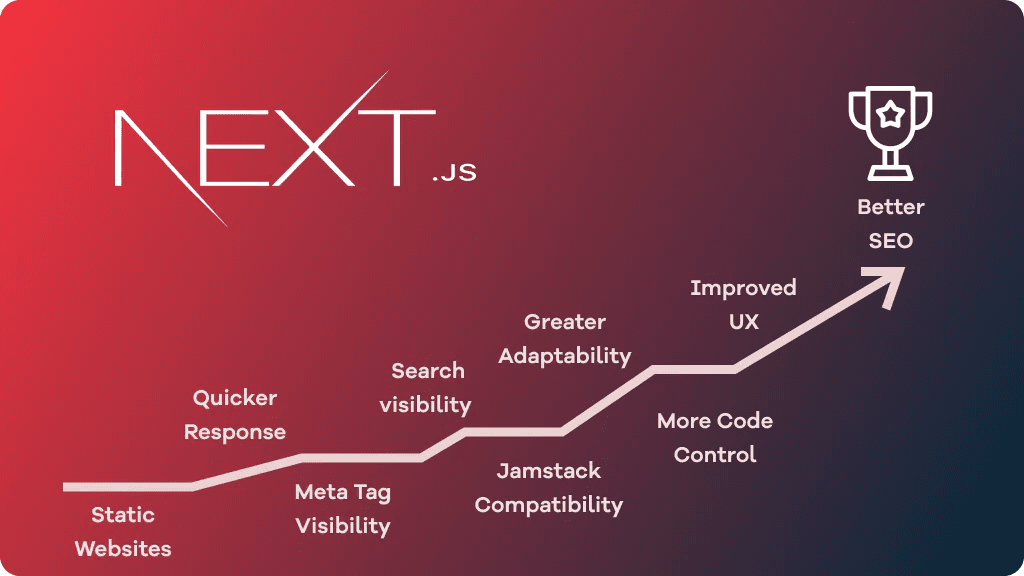
In 2025, Next.js SEO has become a go-to choice for businesses that care about speed, visibility, and long-term growth.
Google now prioritizes performance, user experience, and genuinely helpful content. Thatās exactly where Next.js shines.
In this guide, weāll break down the Next.js SEO trends that are actually working right now, not just theory.
Next.js brings together server-side rendering (SSR), static site generation (SSG), and incremental static regeneration (ISR) in one powerful framework.
In simple terms, search engines can read your pages easily, and users donāt have to wait for content to load.
Hereās why SEO professionals love Next.js:
Pages are pre-rendered, so indexing is faster
Faster First Contentful Paint (FCP)
Strong Core Web Vitals scores
Complete control over metadata and structured data
Itās a win-win for both Google and your visitors.
The App Router has completely changed how SEO works in Next.js.
With Server Components, less JavaScript is sent to the browser, which means better performance right out of the box.
From an SEO perspective, this helps with:
Faster Time to Interactive (TTI)
Cleaner and more readable HTML
Stronger mobile performance signals
Simply put, Google prefers websites that feel fastāand users do too.
The new Metadata API is one of the most underrated SEO upgrades in Next.js.
It lets you manage titles, meta descriptions, canonical URLs, Open Graph data, and Twitter cards in a clean, structured way.
Best practices that work well:
Write unique titles and descriptions for every page
Always use canonical URLs to prevent duplicate content
Add Open Graph data for better social sharing
These small details make a big difference in click-through rates and indexing accuracy.
Google rankings are heavily influenced by Core Web Vitals, especially:
LCP (Largest Contentful Paint)
CLS (Cumulative Layout Shift)
INP (Interaction to Next Paint)
Next.js helps you optimize these automatically by:
Optimizing images behind the scenes
Improving font loading
Lazy loading content by default
š” Pro tip: Always use the Next.js Image component, especially for hero sections.
Big websites donāt rank because of one great pageāthey rank because of many well-structured pages.
Next.js makes programmatic SEO easy using dynamic routes and ISR.
This is perfect for:
Location-based service pages
Product or solution landing pages
Large blog or category expansions
You can scale to thousands of SEO-friendly pages without slowing down your site.
Structured data isnāt optional anymore.
Adding JSON-LD schema helps search engines understand your content better and improves how your pages appear in search results.
You can use schema for:
Blog posts and articles
FAQs
Products and services
Reviews and ratings
Next.js allows clean, server-rendered schema injection, which search engines love.
SEO in 2025 isnāt just about keywords.
Google pays close attention to how users interact with your website.
What works best:
Short, easy-to-read paragraphs
Clear headings (H1, H2, H3)
Smart internal linking
Mobile-first design
Next.js makes smooth navigation and fast page transitions effortless, keeping users engaged longer.
In 2025, Next.js SEO is all about performance, structure, and real user experience.
If your site loads quickly, answers real questions, and follows modern SEO best practices, rankings tend to follow naturally.
Thatās why businesses using Next.js with a solid SEO strategy are consistently outperforming traditional CMS-based websites.